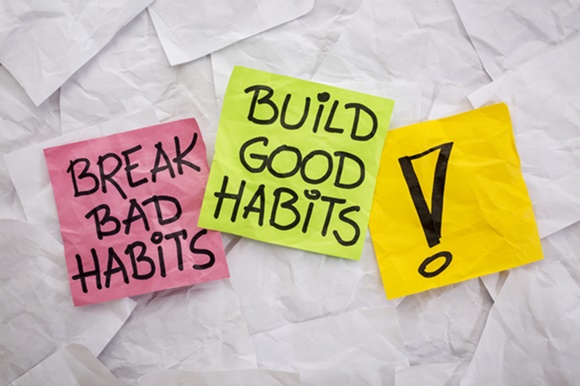
Break Your Bad Habits

I have both good and bad habits. I would really like to change that so I have only good habits. You may be feeling the same way. Our habits define our success. Not only do we desire to develop good habits, we want to squash our bad habits.

If you are ready to start, here is one plan to follow. Determine the habit you wish to break, then apply these 4 actions:

1. Define your “why”. Why is the elimination of this habit important for you? How will it change you? What will you do with the time and resources you save? Create a clear and strong desire to change. Without the internal aspiration and motivation, eliminating a habit will be nearly impossible.

2. Find a better substitute. What can you replace this habit with? Define your plan of action for when you are tempted. This can be as simple or as complex as needed. If you want to stop drinking soda, find something else to replace it, maybe green tea. If you want to reduce the time you spend watching television, use a different activity to unwind in the evenings, maybe reading. This is an opportunity to turn a bad habit into a good habit. Always substitute with something better.

3. Reflect each day on your progress and your purpose. This step cannot be skipped if you are going to succeed. Rarely is our initial desire to change strong enough for us to change overnight. The daily reflection process allows you to reinforce your desire to change. You can use it to determine if your substitute is working. You can continually invigorate yourself with your “why”.

4. Be persistent. We fail when we give up, not before. If you have a bad day, don’t give up. Keep going. To start, you need more good days than bad days. Eventually the good days will outnumber the bad days two to one, then three to one, then four to one, and so forth. Lack of persistence is the ultimate cause of all of our failures. Persistence will always win.

Just writing this article has me ready to tackle at least one of my habits. I hope you will join me in making your daily routine better. Pick a habit you are ready to kill, and let’s get started.

Why Is It So Hard to Be Intentional?

Yesterday I attended the event, Get Motivated Indy. I enjoyed the day, the speakers, the messages, the offers.  But yet, I found myself thinking about why it is so hard to stay motivated, and intentional with our actions. The speakers had everyone energized, excited, and ready to take action. Of course, we know that talking about action is easier than taking action.

I am curious about how many people will follow through with their intentions after yesterday’s event. From my experience the percent is very small. Change is a process, not an event. We can gain inspiration from the event, but that rarely turns into the motivation to make changes in our life. We often lack the persistence to stick with it. We fail to do the work. We fail to change our ideas into actions.

One of my mastermind groups just finished a 15 week study on growing through failure. Our final discussion was about how difficult it is to embrace failure and take risks, even when we know we must. We know risk is the path to success. We know growth happens outside the comfort zone. But yet, it is still hard.

Success is not easy. People want easy. What is going to motivate you to take action? What is going to motivate you through failure? What is going to give you the perseverance to learn from your mistakes?

These are questions that we should continually be asking ourselves. I know this much. It comes from within. You can’t find motivation from a speaker, a book, an event. You can find knowledge. You can find inspiration. But you will not gain motivation.

From yesterday’s event, I discovered some actions and ideas that I want to pursue. Actions I want to be intentional about accomplishing. But the motivation to follow through must come from me.

Why is this important to understand? We are bombarded by motivational messages. They are helpful, only when they touch us in a way that we have a desire to respond. If we are impacted by them, we need to search within ourselves for the motivation to act and be persistent.

How does that happen? I think our motivation is strongest when we have clarity about our purpose, our passion, our goals, our values, and our desired legacy. When we find ourselves inspired and it is aligned with what we want and who we are, we become empowered. Many people fail to become clear on what it is they want to achieve, and why they want to achieve it. Unfortunately, this prevents people from becoming highly motivated.

When you find yourself lacking motivation, what helps you get back on track?


The Crucial Steps in Taking Advantage of Opportunities

One of my mentors explained to me that being in the right place at the right time has nothing to do with success. Instead, it’s critical to be in the right place at the right time with the preparations and awareness required to take advantage of the situation.

How critical is it? Imagine being in a public place requiring medical attention because you have stopped breathing. Who will be able to help you? Will it be someone that just happens to be there? Probably not. It will be the person that is trained in CPR and aware that you need help.

Think of the opportunities you want. Are you prepared with the proper skills, abilities, and services? How will you recognize the need? Do you have what is necessary to allow you to take advantage of the situations that occur throughout your day?

1. Increase Your Awareness. Increased awareness will help you see an opportunity. Learn from others. Spend some time with people that have accomplished what you want to accomplish. Connect with a mentor or coach. Discuss your experiences, and learn from their experience. Develop the ability to recognize when you can add value to a situation. Sometimes you may even need to slow down to become aware of the people and events around you.

2. Be Prepared. To achieve the highest levels of success, you must continuously invest in yourself. The world changes, and your skills become outdated if you are not growing. This is not just a phenomenon in technology. You can observe this in terms of generational differences between people. The success you desire exists within a dynamic world. To embrace it, you must continue to transform also.

Awareness and preparation is the foundation for success, but it also requires that you follow through with action. It is the awareness and preparation that will give you the confidence to act. In most cases this means stepping out of your comfort zone, because that is where the highest levels of success are found.

When have you found yourself prepared and in the right place at the right time? When have you recognized an opportunity but realized you were not quite prepared?

5 Fundamental Lessons to Change Your Thinking About Risk

The more you risk failure, and actually fail, the greater your chances of success. It is rare that anything of value is created or accomplished during the first attempt. Failure, reflection, evaluation, adjustment, and persistence creates your path for success.

Most of us limit the risks we take. We work to avoid failure. We view failure as a negative, and become stuck in our comfort zone. We want more, but are unwilling to risk more.

Here are four lessons that may help you view risk from a different perspective.

1. Who cares if you look bad? Sometimes it is better to care less about looking good. Don’t let the fear of looking bad keep you from taking a risk. Would you rather look good, or find success? Step back and ask yourself this simple question, “Who cares if I look bad?” You normally don’t look good doing something the first time. So just do it.

2. Why are you waiting? Are you waiting for the perfect circumstances before taking action? If you find yourself continually evaluating your options, and gathering more data, stop analyzing. Stop thinking about why you need to wait, and think about why you need to act. You will never have all the data. The faster you move forward, the faster you reach success.

3. Do you have a budget? Create your own budget for risk and failure. Set a goal for your failures. The budget can be based on money, time, or effort. It could include all three. Plan on spending it every month. Make it a habit. This practice provides visibility to how much risk you are actually taking.

4. Where is your inspiration? Is your inspiration based on the value you place on your goal? This may seem obvious. But when your actions are driven by the wrong motives, this question may remind you to get back on track. Are you inspired and motivated by the right reasons? When your values and actions are aligned, you will find risks easier to accept. You are able to move forward faster.

You may read these questions, and think this does not apply to me. I take risks. I am action oriented. It may be true. However, my experience has shown, no matter what level of risk you are used to, everyone has the opportunity to grow in this area. We tend to overestimate the risks we actually take.

This week’s challenge is to evaluate where you are taking risk, and where you are risk adverse. Challenge yourself to find the opportunities that are waiting for you. You may discover something great that you have been avoiding.